rdflib
rdflib.js


Javascript RDF library for browsers and Node.js.
- Reads and writes RDF/XML, Turtle and N3; Reads RDFa and JSON-LD
- Read/Write Linked Data client, using WebDav or SPARQL/Update
- Real-Time Collaborative editing with web sockets and PATCHes
- Local API for querying a store
- Compatible with the RDF/JS data model specification
- SPARQL queries (not full SPARQL - just graph match and optional)
- Smushing of nodes from
owl:sameAs, andowl:{f,inverseF}unctionProperty - Tracks provenance of triples keeps metadata (in RDF) from HTTP accesses
Documentation
See:
-
The API documentation is partial but useful


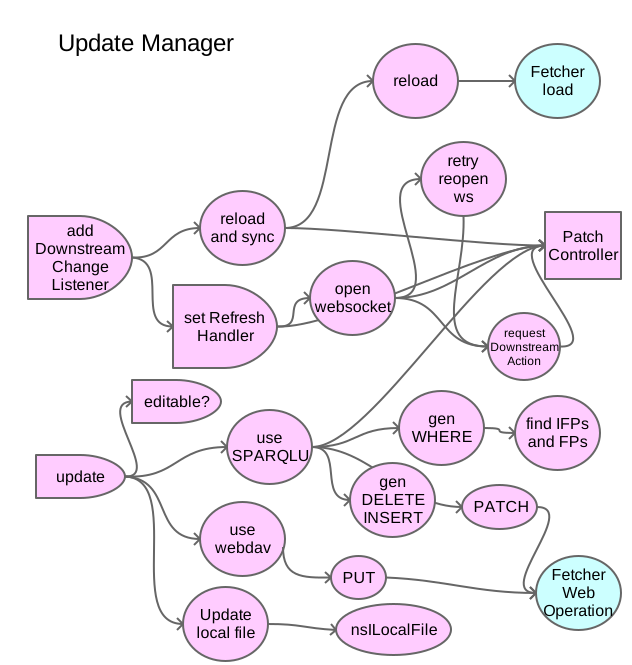
for more information.
Install
Browser (using a bundler like Webpack)
npm install rdflib
Browser (generating a <script> file to include)
git clone git@github.com:linkeddata/rdflib.js.git;
cd rdflib.js;
npm install;
Generate the dist directory
npm run build:browser
Node.js
Make sure you have Node.js and Node Package Manager (npm) installed.
npm install --save rdflib
Creating terms
rdflib implements the RDF/JS data model specification: terms are created with the factory functions namedNode(), blankNode(), literal(), variable() and quad(), all exported from the package root (sym() is an alias for namedNode()).
Note that, per that specification, literal() takes two arguments — the second one is either a language tag or a datatype:
literal(value: string | number | boolean | Date, languageOrDatatype?: string | NamedNode): Literal
For example:
import { literal, namedNode } from 'rdflib'
literal('chat') // plain string literal ("chat"^^xsd:string)
literal('chat', 'fr') // language-tagged literal ("chat"@fr, datatype rdf:langString)
literal('2019', namedNode('http://www.w3.org/2001/XMLSchema#gYear')) // typed literal
literal('2019', 'http://www.w3.org/2001/XMLSchema#gYear') // same, with the datatype IRI as a string
literal(4) // convenience form: infers the datatype ("4"^^xsd:integer)
A string second argument is interpreted as a datatype IRI when it contains a colon, and as a language tag otherwise.
A common pitfall (present in some older tutorials) is calling literal(value, undefined, datatype): the factory function ignores the third argument and returns a plain xsd:string literal. The three-argument form only exists on the class constructor, new Literal(value, language, datatype). To create a typed literal with the factory function, pass the datatype as the second argument, as shown above.
owl:sameAs smushing and link#uri statements
"Smushing" is the merging of everything a graph knows about two identifiers which are stated to denote the same thing. Stores perform no smushing by default (see #458); you opt in per feature when creating the store:
const kb = $rdf.graph(['sameAs', 'InverseFunctionalProperty', 'FunctionalProperty'])
With the sameAs feature enabled, whenever a statement A owl:sameAs B is added the store equates the two nodes: one of them is chosen as canonical and all statements are re-indexed under it, so queries about either identifier see the merged data. The InverseFunctionalProperty and FunctionalProperty features likewise equate nodes which share a value of such a property.
When two nodes are equated, the store records the equivalence by adding one statement of the form:
<canonical> <http://www.w3.org/2007/ont/link#uri> <obsoleted> .
that is, a back-link from the canonical node to the identifier it replaced. This is internal book-keeping: it is how the store remembers aliases, so that store.uris(term) and store.allAliases(node) can list all the identifiers something is known by. It is stored like any other statement, though, so you may encounter these triples when querying or serializing a store that has smushing enabled. If a Fetcher is attached to the store, equating two nodes also triggers a look-up of the newly-learned alias, so that data published under either URI gets loaded.
The same http://www.w3.org/2007/ont/link# namespace is also used by the Fetcher for the HTTP metadata (requests, responses, status codes) it records; that metadata lives in a separate metadata graph and can be removed with store.removeMetadata(doc).
Serializer flags
The Turtle/N3/JSON‑LD serializers accept an optional flags string to tweak output formatting and abbreviation behavior.
- Pass flags via the options argument to
serialize(...):
import { graph, serialize, sym } from 'rdflib'
const kb = graph()
const doc = sym('http://example.com/doc')
// ... add some statements ...
// Example: prevent dotted local parts in prefixed names
const turtle = serialize(doc, kb, doc.value, 'text/turtle', undefined, { flags: 'o' })
Common flags used internally (you can combine them, e.g. 'o k'):
si– used by default for Turtle to suppress=,=>notationsd e i n p r s t u x– used for N-Triples/N-Quads to simplify outputdr– used with JSON‑LD conversion (no default, no relative prefix)o– new: do not abbreviate to a prefixed name when the local part contains a dot. This keeps IRIs likehttp://example.org/ns/subject.examplein<...>form instead ofns:subject.example.
Notes:
- For Turtle and JSON‑LD, user‑provided flags are merged with the defaults so your flags (like
o) are honored. - By contrast, passing
'p'disables prefix abbreviations entirely (all terms are written as<...>IRIs).
Contribute
Subdirectories
dist: Where the bundled libraries are built. Runnpm run buildto generate them.test: Tests are here.lib: Transpiled, non-bundled library is built here when the library is published to npm.
Dependencies
- XMLHTTPRequest (Node.js version)
Thanks
Thanks to the many contributors who have been involved along the way. LinkedData team & TimBL
LICENSE
MIT